
AI agents are about to get more expensive
How to capitalize now

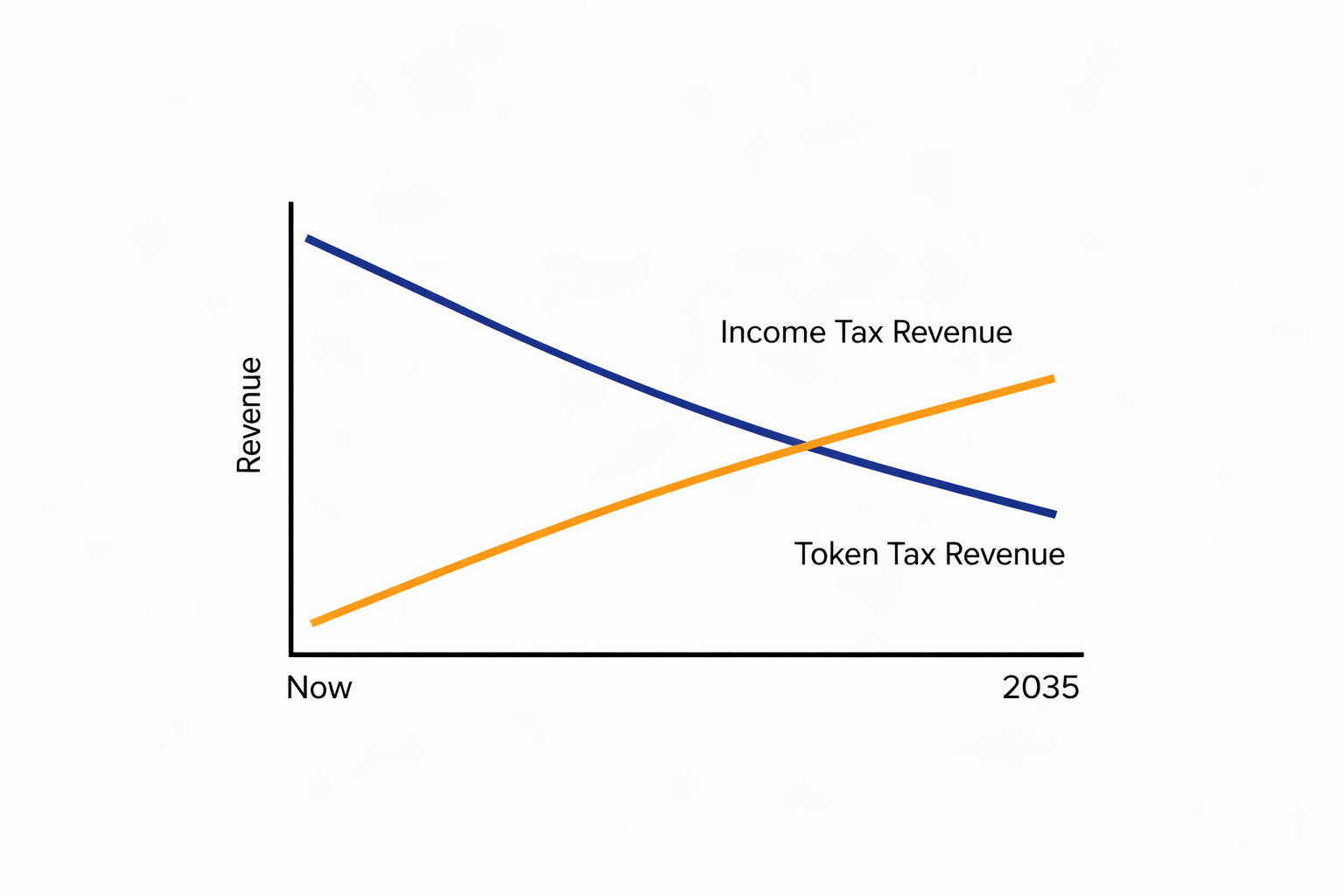
As we all know, AI is creating huge productivity gains in every industry, which in turn has led to a reduction in jobs. It’s not quite as simple as AI bots replacing people yet, but rather that AI extends the ability of individuals to create more output and therefore do the work of more people.
This is a big problem for governments as it massively undercuts their ability to tax workers and fund public services.
Ultimately, this means that governments need to tax somewhere else and the obvious place to tax is the thing that is replacing the workers. That’s the AI.
AI already has quantitive usage built-in and that’s tokens. Complex requests to an LLM consume more tokens than a simple question. Therefore, it’s already perfectly setup for taxation:
more work = more tokens = more tax
It’s the payroll tax equivalent for non-human workers.
It’s also easily traceable, making it much more efficient for governments to tax business owners. It could probably even be taxed automatically.
But there’s a problem. The economics of AI don’t work yet…
Sponsored by Pipedrive

If you're selling anything, you need a CRM. But most CRMs are built for large sales teams, not founders doing everything themselves. Pipedrive takes the opposite approach: a visual, drag-and-drop pipeline where every deal has a next action, so nothing gets forgotten. It connects with 400+ tools, and the AI features are practical, handling things like email drafting and deal prioritisation. Plans start at $14/month per seat. Worth a look if spreadsheets are still your CRM. Tiny Empires readers get an extended trial and 20% off their first year.
The economics of AI don’t work (yet)
OpenAI reportedly lost $8-13 Billion in 2025. Anthropic, Google, and the rest are burning cash at similar rates. They all offer a product that is mostly free, or $20/month. They’re all also heavily funded. They’re happy to run at a loss for now, but they can’t continue to raise more funds forever. The funding will eventually run out.
There are a couple of different directions things could go.
Scenario 1: The AI companies increase their pricing significantly. Current pricing is probably 10x less than they would need to charge to support their existing growth rates. If this plays out, we're in a period where AI is underpriced for the end user, and building with it now costs a fraction of what it will cost in several years. For solo founders, that's a window worth using.
Scenario 2 is a little different. All the LLM companies seem intent on maximising user adoption. I suspect they will do everything possible to maintain that adoption curve and avoid large price increases. But without investors, this can’t be sustained. That leaves governments stepping in to fund the AI companies. There are many different structures this could take, but what we would likely see is a strong relationship forming between governments and AI companies, where governments rely on AI companies for taxation revenue and AI companies need governments because public funding is the only thing that keeps the economics viable. Each side holds something the other can’t get elsewhere. That mutual dependency would reshape both industries, and we’d find ourselves living under a strange tech-government hybrid.
Capitalizing now
If token taxation becomes a reality, it would add friction to AI usage. People would think twice about asking LLMs simple questions. To prevent this, the AI companies would likely keep some sort of free tier that would not be taxable to keep users engaged, with tax kicking in for business use.
The good news is that the tax framework doesn't exist yet and so now is the time to capitalize. The founders deploying agents now get the productivity gains at current costs. As a solo founder, we can get 10x more done than was possible even six months ago, with minimal cost overhead. My £18/month Claude subscription alone delivers a significant amount of value.
To take advantage of current costs and this tax-free period: learn what works now, build your processes, and absorb the efficiency into your margins before any tax structure arrives.
The companies that wait will adopt agents and start paying tax on them at the same time. Early movers build an advantage that late adopters can't replicate.
This is my prediction on the way I see things going. I could be wrong. What are your thoughts? Let me know in the comments.
Ready to build a 6-figure solo business?
Depending on your goals, there are 2 ways we can work together:
JOIN PRO MEMBERSHIP Learn more
Get full access to all our resources with Pro Membership for a one-time payment of $149.
💰$50k in Perks: Access Exclusive offers from the top no-code tools who have partnered with us. Including $15k waived Stripe fees, $500 Bubble credit + $1000 Coda credit View all
💻 No-Code Operating System: Advanced Notion template that replaces all your productivity tools. Everything you need to launch and manage your business from one page. Learn more
🎓 Course: Tiny Empires Method: Learn how to build a 6-figure business that works around your life and not the other way around. Learn proven frameworks to stop wasting time and start making money. Learn more
🎓 Course: Sales for Introverts (and people who don’t like selling): Learn how to sell in a way that fits your personality and delivers consistent, reliable revenue for your busines. Learn more
🛠️ 75+ Curated No-Code Courses and Resources: We’ve curated 2000 no-code videos into 75+ easy to navigate courses. Save yourself hours of watching Youtube videos that don’t move your knowledge forward. View all
SPONSOR THIS NEWSLETTER Learn more
Want to get in front of 34k+ other founders and makers building business faster using no-code and AI tools.