
Do the same boring things everyday
The work that grows your business never feels like an achievement

Not all effort is created equally. If you’re building a Tiny Empire, the biggest challenge is time. It can often feel completely demoralizing when we put in a ton of effort, but the business doesn’t grow much at all.
With hundreds of tasks competing for our attention, we often focus on the most exciting ones, or the big one-off pushes. Launches, redesigns, a big campaign. Psychologically this feels like progress.
Unfortunately I spent over a decade with this mentality.
Don’t chase big wins. Focus on simple daily routines.
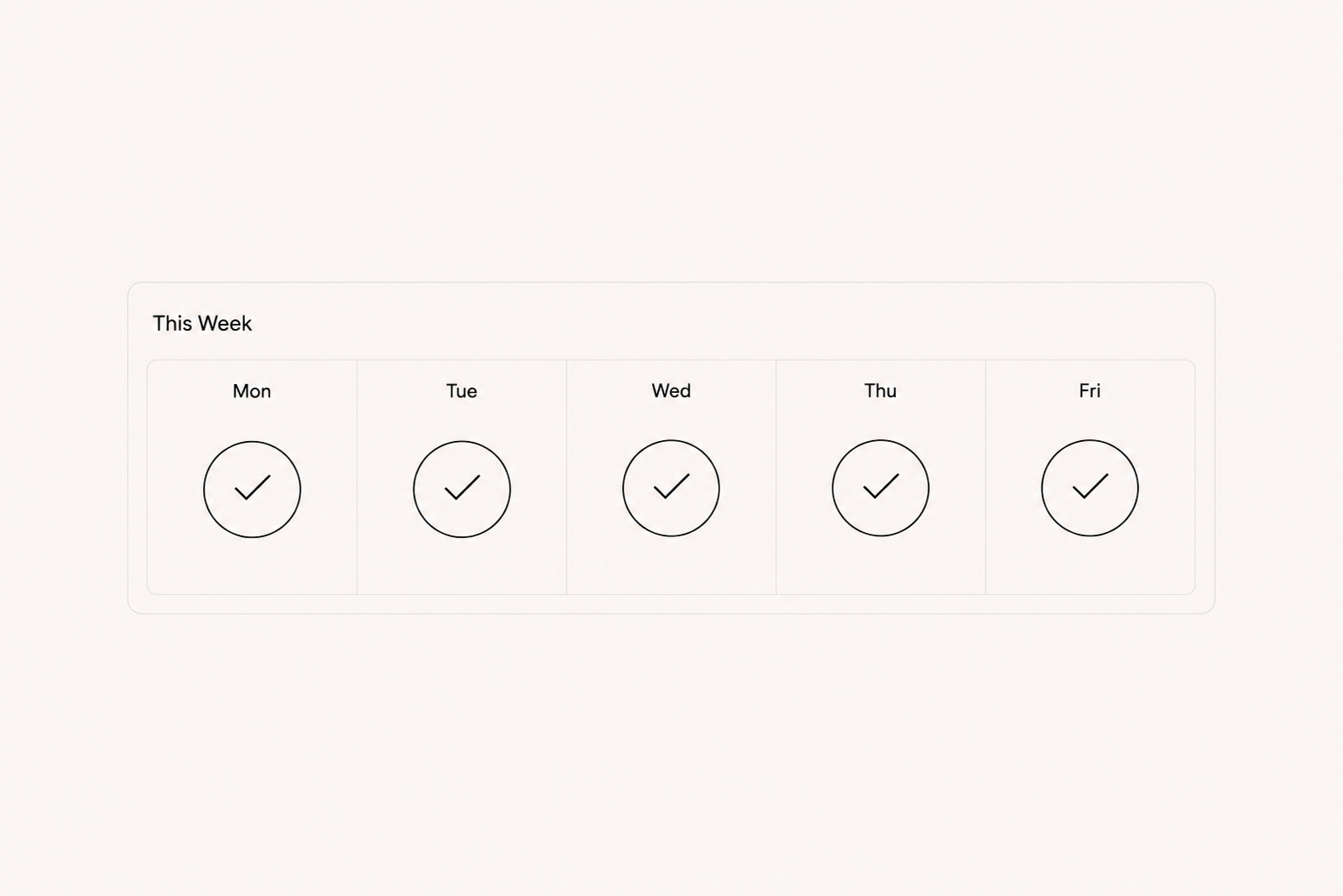
We’ve all been sold the lie that an entrepreneur’s calendar is supposed to be wildly different every day, with progress arriving in sudden heroic spikes.
But it doesn’t work for a few reasons:
Big tasks produce a spike, not a slope. They don’t compound.
They carry high restart friction. Every one means re-planning and context-switching before real work starts.
The real compounding work gets de-prioritized.
You end up dependent on big wins, needing another big push just to feel like you’re moving.
But don’t worry. As a Tiny Empire builder, you can make some tiny adjustments to how you work, that transforms your work week into an efficient, compounding machine.
Here’s how to do it, step by step:
1. Identify the work worth repeating
Some repeated work isn’t worth repeating, and some one-off work is essential. The job is separating tasks that get more valuable each time you do them from tasks that just need doing once. Start by identifying the high-level areas that will make your business work. For example, this might be:
Sales
Awareness
SEO
Once you have these, think about the highest value tasks you can do each day to feed each one. Think about inputs, rather than outputs. You can’t control how many people book calls with you, but you can control how many people you reach out to.
The tasks for the above areas, might look like this:
Sales → reach out to 2 companies with a high-quality manual email
Sales → send follow-up emails
Awareness → LinkedIn post
Awareness → LinkedIn commenting for 30 minutes
Awareness → 20x LinkedIn connections
Website → draft a blog post and publish
Website → submit to Google Search Console
Looking at the above tasks, you start to see a flywheel forming.
Sales > LinkedIn connections > LinkedIn content > Website > Sales
Each task feeds into other tasks and back to the beginning. The longer you do these tasks consistently, the flywheel spins faster and faster.
2. Allocate your output for each task
Once you have your tasks, give them a structure to help you stay consistent and avoid restart friction.
I like to put my easiest tasks first. This gets me moving. I also group tasks of a similar kind together so that there is less context switching.
Some tasks are naturally open-ended. For example, clearing your inbox should almost always be included in your daily tasks, but it doesn’t have a fixed amount of time for completion. This is perfectly fine.
Where possible however, making your tasks less open-ended will help psychologically.
For example, sending 3 strong sales emails is much easier psychologically, than sending sales emails for 30 mins.
Making your tasks as fixed as possible in this way, will help you power through them.
3. Protect the daily routine from real life
Don’t put too much emphasis on streaks. This is not about perfection, but on persistence. And persistence doesn’t always look the same. Try not to miss 2 days in a row. If you miss one, commit to starting again the next day if circumstances allow.
Don’t build unrealistic task levels. Being overly ambitious can sometimes have the opposite effect. Being consistent on a small level, will outperform sporadic high-levels of output.
If you can’t get everything done on one day, doing some of it is better than nothing. Try doing a light version of each task, rather than cutting tasks completely.
What about your one-off tasks?
Keep these going, but prioritize your daily tasks. The daily task schedule should be the first thing you do each day, then use your remaining time to get your one-off tasks done. A warning on this though. The one-off tasks are often psychologically more rewarding. This can make you rush through the daily tasks, cutting corners on quality to get to the “real” work. Don’t. Make sure that your daily tasks are done well.
Applying this to your own business
None of this needs more effort from you. If you’re building on the side with a few hours a week, you don’t have the time for heroic pushes anyway, and that’s the whole point. Pick a few tasks that compound, give it a structure you can commit to, set the level low enough to hit on your worst week, and let a year of small deposits do the rest. The challenge is that it doesn’t feel like progress most days. But that’s why so few people stay with it long enough to see the return. Some weeks the business needs a lot of one-off work that takes priority, but make the boring daily routine the foundation you come back to and the benefits will accumulate.
If you enjoyed this newsletter, you may be interested in joining No Code Founders, our sister community of 38k+ founders and operators building businesses without code. It’s free → Learn more
SPONSOR THIS NEWSLETTER Learn more
Want to get in front of 38k+ other founders and makers building business faster using no-code and AI tools.